

Liquidity Bridges
Trust and safety is vital
Bridges occupy an exceptionally sensitive position, acting as the gateway between two financial systems. They must be robust and secure to instil confidence in users, protocols, and institutions regarding the assets issued through them.
Any risk introduced into the bridging process will, at some point, be tested. If such a risk materialises, the resulting failure could be catastrophic—potentially destabilising an entire ecosystem.
The USDC depegging event underscored this vulnerability, ultimately requiring intervention from the US government. Similarly, the BUSD depegging event led to a collapse in market capitalisation from $16 billion to $2 billion.
Conversion Between Shares and Tokens Without Price Risk
The S1 bridge provides a direct, price-stable pathway between traditional shares and blockchain-based tokens. This system ensures that tokens can always be redeemed for their corresponding shares—and vice versa—regardless of market conditions.
S1’s German entity acts as custodian, holding the underlying assets under a ring-fenced structure. For every token minted, a corresponding share is held in custody on a 1:1 basis at all times.
Minting Process
- The user transfers shares to the trust.
- The trust verifies receipt of the shares.
- The trust mints the equivalent number of tokens to the user.
Burning Process
- The user initiates a token burn.
- The trust verifies the burn.
- The trust transfers the corresponding shares to the user.
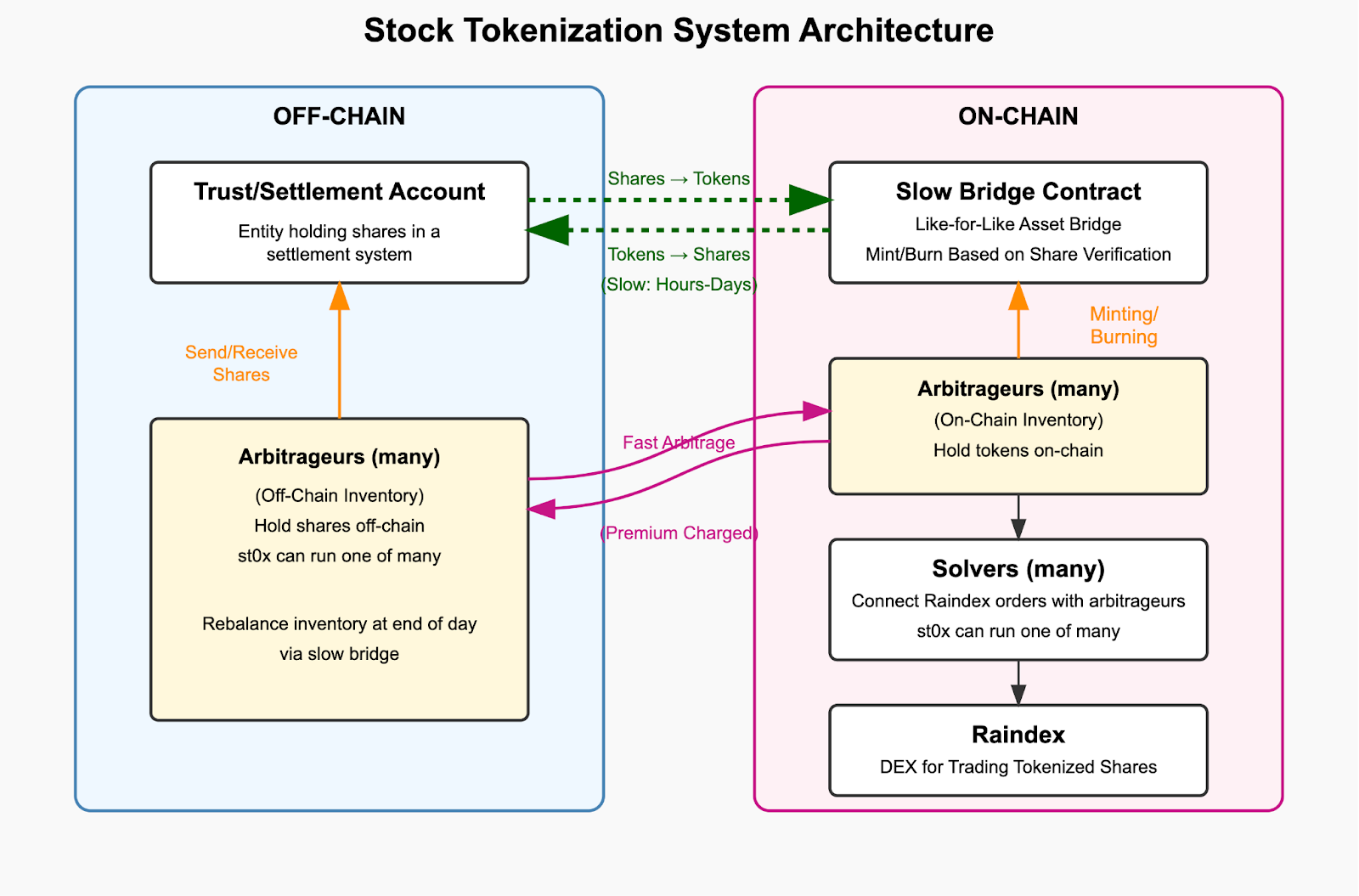
Arbitrageurs: Aligning On-Chain and Off-Chain Prices
Arbitrageurs play a vital role in maintaining price alignment between tokenised assets on-chain and their corresponding shares off-chain. By holding inventory in both environments, they provide faster liquidity and help stabilise price discrepancies. Importantly, if an arbitrageur exhausts inventory in one direction, it does not represent a systemic failure—only a temporary inefficiency.
These independent entities maintain inventories of both on-chain tokens and off-chain shares. They offer rapid conversions, often at a premium, with many competing to provide the most efficient pricing.
How Arbitrage Works
An arbitrageur monitors prices and trades when a disparity arises between the token price on-chain and the share price off-chain. When a significant imbalance in inventory builds up, they periodically rebalance through the slower bridge mechanism (e.g., daily).
Example
An arbitrageur holds 1,000 TSLA tokens on-chain and 1,000 Tesla shares off-chain.
- They observe TSLA tokens trading on-chain at $252, while Tesla shares are trading off-chain at $250.
- They sell 1 TSLA token from their on-chain inventory.
- They buy 1 Tesla share off-chain through their brokerage account.
- This captures a $2 profit (minus fees) and maintains a relatively balanced inventory.
If the on-chain price remains higher throughout the day, and the arbitrageur repeats this process, by day’s end they might hold 50 TSLA tokens on-chain and 1,950 Tesla shares off-chain. To rebalance, they transfer 950 shares via the slow bridge to mint 950 tokens, restoring their 1,000/1,000 balance for the next trading cycle.